
TL;DR
Written by Maria Skakun (LinkedIn), Partner, Head of Business Development at Bienrock
- Most OnlyFans agencies pay creators through a small set of tools — Cosmo Payment, Paxum, Wise, or crypto — because very few banks are willing to open a payment account for an individual creator at all.
- The real problem isn’t that banks dislike OnlyFans as a category — it’s that these tools pay the creator directly, which leaves the agency with no visibility into that account and no guarantee the money actually reaches them.
- A second gap is geographic: Paxum and Cosmo don’t cover every country a roster is based in, and where they do operate, fees run high.
- A third gap is concentration risk: an agency running its whole operation through one or two accounts is one freeze away from being unable to pay anyone.
- A small number of banks will open a master account for the agency with a separate sub-account for each creator underneath it, so the agency keeps visibility and control while each creator still has their own identified account.
- Spreading volume across more than one such banking relationship, instead of concentrating it in one, is what actually reduces freeze risk at scale.
Ask an OnlyFans agency how they pay their creators, and the honest answer is usually some combination of Cosmo Payment, Paxum, Wise, and crypto — not because any of these is ideal, but because almost no traditional bank will open an account for an individual OnlyFans creator, and this short list is what’s left. That gap shapes everything downstream: creators end up holding their own payment accounts outside the agency’s control, coverage breaks down in certain countries, and fees climb wherever it is covered. None of this is really a story about banks disliking adult content — it’s a structural problem with how few institutions are willing to bank individual creators directly, and what agencies do to work around that. This post covers what the current setup actually looks like, the three problems it creates, and what a properly built alternative looks like.
Why is banking different for an OnlyFans agency than for an individual creator?
An individual OnlyFans creator only needs one thing: somewhere to receive their own payout. An agency needs something structurally different — a way to receive, keep visibility over, and distribute earnings across an entire roster of creators, many of whom already have (or need) their own payment account. That distinction is why tools built around a single creator’s payout — Cosmo Payment, Paxum, a personal Wise account — don’t scale cleanly into an agency’s problem, even though they’re often the only accessible option for that individual creator in the first place. Agencies representing more than a handful of creators typically feel this gap within their first year of scaling.
Cosmo Payment, Paxum, and Wise cover most of what OnlyFans agencies actually use today — and each does one part of the job, not the whole job.
Cosmo Payment (London-based) issues virtual and physical debit cards and processes payouts and ATM withdrawals for individual creators, and comes up constantly in agency banking discussions as backup coverage when Paxum isn’t available in a creator’s country. Paxum is the more established adult-industry-specific option — a wallet and card built specifically for the sector — but it isn’t available to creators based in the US. Wise and similar multi-currency apps get used mainly for EU/UK creators who need standard SEPA or bank-transfer coverage. Crypto/USDT payouts are the fastest-growing option, used mainly where none of the above work, or where a creator prefers to stay off traditional rails. Most agencies end up running two to four of these tools simultaneously, because no single one covers the whole roster.
The core problem isn’t that banks reject OnlyFans — it’s that almost none of them will open an account for an individual creator, so the creator, not the agency, ends up holding the money first.
Very few banks or EMIs are willing to open a payment account for an individual adult-content creator at all — Cosmo Payment and Paxum are two of the small number that will. That means, in practice, OnlyFans pays out into an account the creator controls, not the agency. For the agency, that creates a real risk: no visibility into that account’s balance or activity, and no actual guarantee the agreed share ever gets forwarded — the agency is trusting the creator’s account and the creator’s cooperation, not a controlled financial setup. This is the part that rarely gets talked about, because it isn’t a “banks don’t like us” problem — it’s a structural gap in who is actually allowed to hold the money.
Paxum and Cosmo don’t cover every country a roster is based in, and where they do, the fees are some of the highest in the stack.
Paxum isn’t available to US-based creators at all, and both tools have gaps across large parts of Asia, Africa, and Latin America — exactly where a growing share of rosters are based. Where they are available, fees typically run 1-4% plus load or fixed fees per transfer, which compounds fast across a roster of any real size. Agencies with creators in countries neither tool serves are usually left improvising with crypto or informal transfers, which brings its own compliance exposure.
Running an agency’s entire payout operation through one or two accounts means one freeze can stop every creator from getting paid.
Payment-card fintechs built for individual consumers restrict or freeze accounts for reasons that often have nothing to do with adult content specifically — unusual volume, transaction patterns that look like business activity on a personal-tier account, or a routine compliance review. When an agency has concentrated its volume into one or two of these accounts, a single freeze doesn’t just cost fees — it stops payroll for the whole roster, with no relationship manager to call and no fallback already in place.
What a properly built setup looks like — and how Bienrock arranges it
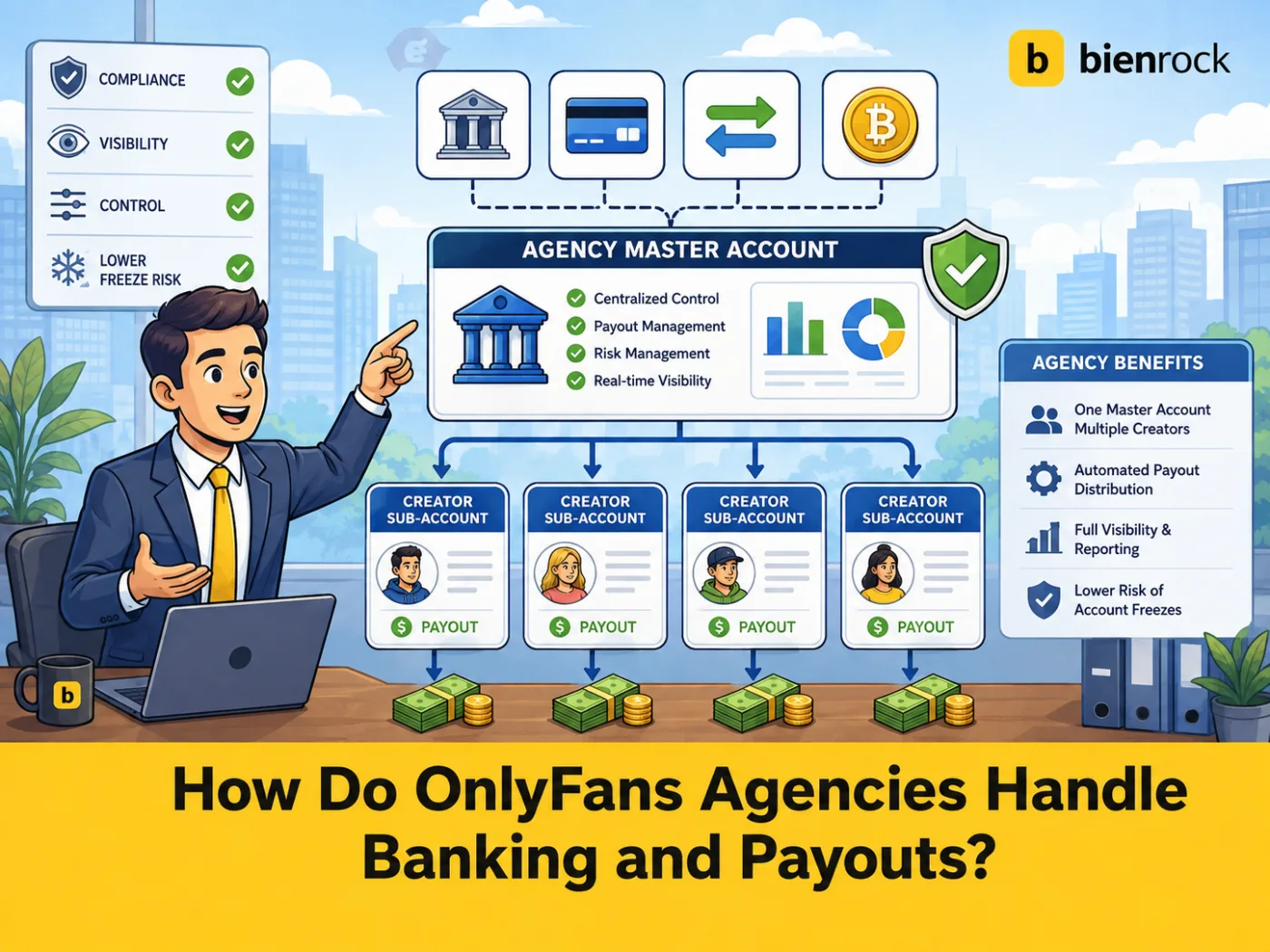
The fix for all three problems above isn’t a better version of Cosmo or Paxum — it’s a different account structure entirely: a master account held by the agency, with a separate sub-account underneath it for each creator. OnlyFans pays into the creator’s sub-account, so each creator still has their own identified account for compliance purposes — but the sub-account sits inside the agency’s master account, giving the agency real visibility into balances and activity and removing the “trust the creator to forward it” risk entirely. A small number of banks offer this kind of setup for creator-management agencies specifically, but they don’t advertise it publicly — it’s arranged relationship by relationship, not something an agency finds by searching for “OnlyFans agency bank account.” Bienrock works with several of these banks directly, which matters for the second and third problems too: different banks cover different creator geographies, and spreading volume across more than one banking relationship is what actually protects an agency from a single freeze taking down the whole operation. More at bienrock.ch .
How this differs from adding another payout app
The default response to hitting a limit with Cosmo, Paxum, or Wise is to sign up for one more tool. That doesn’t fix any of the three problems above — it just adds another account the agency doesn’t fully control, another fee structure, and another point of failure. A master account with creator sub-accounts, spread across more than one bank, solves the actual structural problem: who holds the money, whether the agency can see it, and what happens if one relationship goes down. It isn’t a new app to sign up for — it’s a banking relationship Bienrock arranges directly with institutions that already do this for other agencies.
Frequently asked questions
Q: How do OnlyFans agencies handle banking and payouts?
A: Most rely on a mix of Cosmo Payment, Paxum, Wise, and sometimes crypto, because very few banks will open a payment account for an individual creator. Agencies that outgrow this patchwork typically move to a master account with a dedicated sub-account for each creator, held with a bank that already works with creator-management agencies.
Q: Why won’t banks open accounts for OnlyFans creators directly?
A: Most retail banks and even many EMIs simply don’t have risk appetite for individual adult-content creators, regardless of income level — it’s a policy decision, not a case-by-case review. Cosmo Payment and Paxum are two of the few that do, which is why they’re used so widely despite their limits for agencies specifically.
Q: What is a master account with sub-accounts for an OnlyFans agency?
A: It’s a banking structure where the agency holds one main corporate account, and each creator has their own sub-account underneath it — funds land in the creator’s identified sub-account, but the agency has full visibility and control at the master-account level, rather than relying on a creator’s separate, personal account.
Q: Is Paxum or Cosmo Payment enough for a growing OnlyFans agency?
A: For a small roster, often yes — both cover a narrow but real need. They become a liability once an agency has creators in countries neither tool supports, or once the agency is concentrating meaningful volume into one or two accounts it doesn’t control — at that point the risk isn’t the fees, it’s the lack of visibility and the freeze exposure.
Q: What happens if a creator’s Cosmo Payment or Paxum account gets frozen?
A: Payouts to that creator stop until it’s resolved, and because the account belongs to the creator rather than the agency, the agency typically has limited ability to intervene directly. A master-account structure avoids this specific failure mode because the agency, not just the creator, has standing on the account.
Q: Can an OnlyFans agency get a real business bank account?
A: Yes, but not usually from a generalist bank applying cold — 60-80% of these applications get rejected before reaching underwriting. It requires an institution that already has risk appetite for the sector, typically reached through a direct introduction rather than a public application.
Key takeaways
- Most OnlyFans agencies patch together Cosmo Payment, Paxum, Wise, and crypto because very few banks will open an account for an individual creator at all.
- The core risk isn’t bank sentiment toward adult content — it’s that these tools pay the creator directly, leaving the agency with no visibility and no guarantee of being paid.
- Paxum and Cosmo don’t cover every country a roster is based in, and fees run highest exactly where coverage does exist.
- Concentrating payout volume into one or two accounts means a single freeze can stop payroll for an entire roster.
- A master account with a dedicated sub-account per creator solves the visibility and guarantee problem directly.
- A small number of banks offer this structure for creator-management agencies, but they don’t advertise it — it’s accessed through a direct relationship, not a public application.
- Spreading volume across more than one such banking relationship is what actually protects an agency from concentration risk.
Conclusion
The tools most OnlyFans agencies start with — Cosmo Payment, Paxum, Wise, crypto — exist because almost nothing else will take an individual creator as a customer, not because they were built to run an agency’s finances. That’s the real gap: visibility, guarantee of payment, geographic coverage, and what happens when one account goes down. A master account with a sub-account for every creator, spread across more than one bank willing to do this, closes that gap without asking the agency to restructure anything about how it operates. If your agency’s payouts are still running through creators’ own Cosmo or Paxum accounts, bienrock.ch is where that conversation starts.
A note on the names used in this article
Cosmo Payment, Paxum, and Wise are trademarks of their respective owners. Bienrock is not affiliated with, sponsored by, or endorsed by any of these companies — this article is independent commentary drawing on each company’s own public product listings and third-party agency payout comparisons, current as of August 2026. Terms and coverage can change; confirm directly with the provider.