
TL;DR
Written by Maria Skakun (LinkedIn), Partner, Head of Business Development at Bienrock
Helping fintech and crypto companies access banking infrastructure globally.
- Banks reject crypto, forex, and trading companies not because these businesses are illegal, but because most institutions have excluded these sectors at policy level — before any individual application is reviewed.
- The rejection mechanism is structural: sector classification systems flag these business models at intake, and most applications never reach a compliance officer or underwriter.
- The Compliance Translation Layer, used by the team at Bienrock, addresses the three root causes of rejection: sector-level exclusion, documentation mismatch, and relationship routing failures.
- Fixing a rejection requires more than improving documents — it requires selecting the right institution type, understanding that institution’s specific risk appetite, and routing the application to decision-makers rather than front-office staff.
- Bienrock acts as an intermediary, introducing high-risk companies to banking and payment partners with genuine appetite for these sectors, and supporting the full onboarding process.
- Companies that address all three root causes simultaneously open accounts within 4–8 weeks; those that address only documentation continue accumulating rejections for 3–6 months or longer.
Introduction
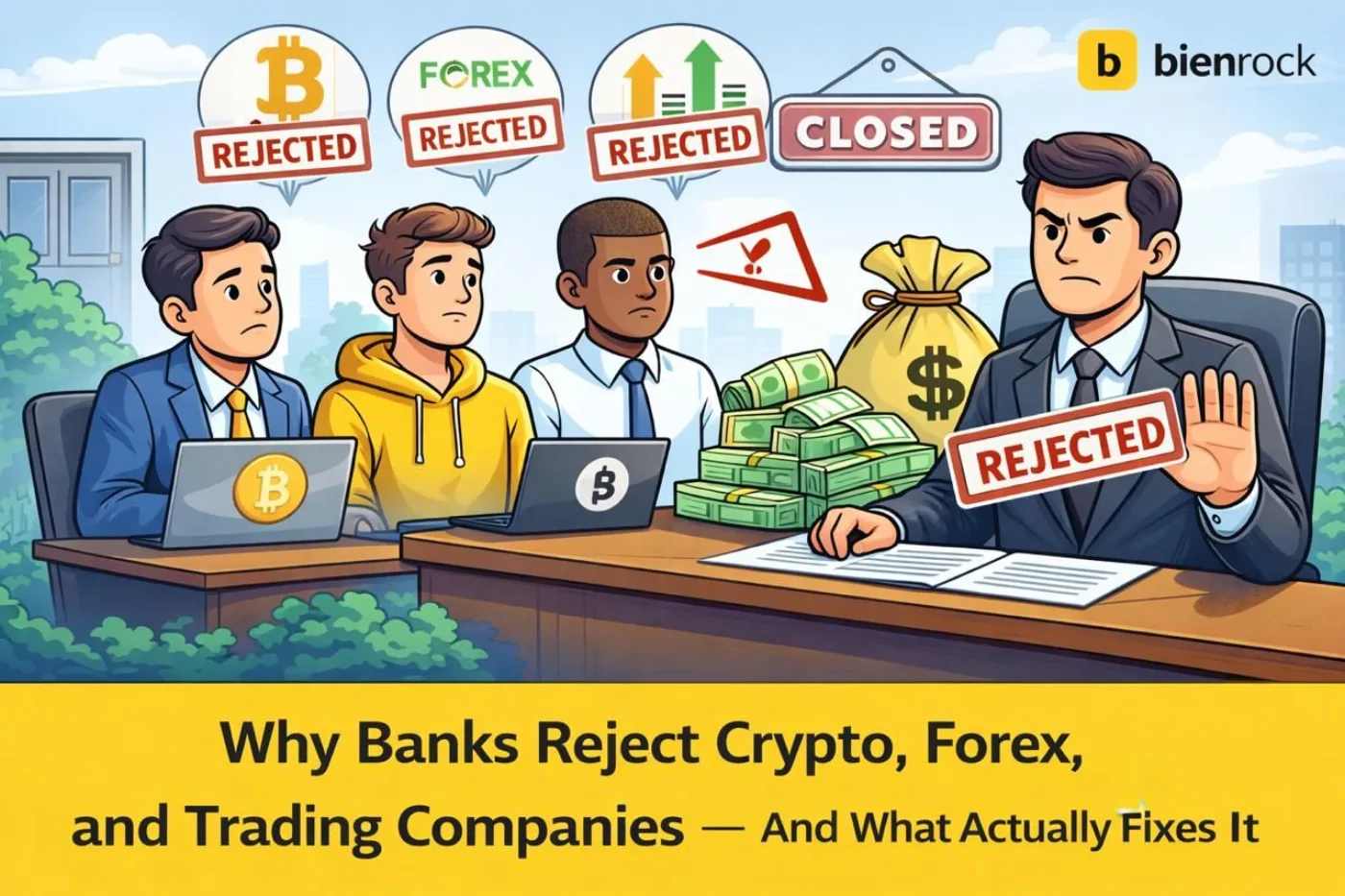
Banks reject crypto companies, forex brokers, and trading firms at a rate that has no parallel in other sectors. The companies affected are often profitable, well-structured, and fully licensed — yet they face rejection after rejection, with little explanation and no clear path forward.
The standard advice — improve your AML policy, get a better lawyer, try a different bank — addresses the wrong problem. It assumes the rejection is a documentation problem. In most cases, it is not.
This post explains the actual mechanisms behind bank rejections for high-risk businesses, why the standard fixes fail, and what a structured approach to this problem looks like in practice.
What “High-Risk” Actually Means to a Bank
When a bank classifies a business as high-risk, it is not making a moral judgment. It is applying an internal risk framework that assigns compliance cost, regulatory exposure, and reputational risk to different business model categories.
Crypto exchanges, OTC desks, forex brokers, and trading companies sit in a category where the compliance cost of onboarding — the due diligence required, the ongoing transaction monitoring, the regulatory reporting obligations — is high relative to the revenue the client relationship generates for the bank. Many banks have made a straightforward commercial decision: the cost-benefit analysis does not work, so they exclude the sector entirely.
This is the foundational insight that most rejected companies miss. The bank is not saying the business is suspicious. It is saying the sector is not worth the compliance overhead at the standard client tier. Understanding this reframes the entire strategy for what to do next.
The Three Mechanisms Behind Every Rejection
The first rejection mechanism is sector-level exclusion, and it operates before any human reviews the application.
Banks use automated classification systems that tag incoming applications by industry code, business model description, and transaction type. A crypto exchange or forex broker can be declined within hours of submission — not because a compliance officer reviewed the business and found problems, but because an automated filter identified the sector and routed the application to a decline queue. No amount of documentation quality changes this outcome. The application needed to go to a different institution, or through a different channel inside the same institution.
The second mechanism is documentation mismatch — applying with a document set that was not built for the specific institution.
Banks have individual compliance frameworks, not a universal standard. One institution’s enhanced due diligence process may focus heavily on beneficial ownership and source of funds. Another prioritises transaction flow documentation and correspondent banking relationships. A third may require a specific AML policy format that maps to its internal review template. A document pack built generically — even a high-quality one — will fail at institutions whose specific requirements it does not address. Companies that reuse the same pack across multiple banks are not improving their position with each submission. They are confirming the mismatch repeatedly.
The third mechanism is relationship routing — submitting through channels that have no authority to approve high-risk applications.
Many banks publicly state that they work with crypto or fintech clients. What they do not publish is that inbound applications through their general contact form or business banking intake process are handled by relationship managers who have limited risk authority and strong incentives to decline anything outside their standard client profile. The same application, introduced directly to the right team inside the institution — the team that actually manages high-risk or specialised client relationships — goes through a materially different review process. This is not a loophole. It is how banking relationships have always worked for complex client types.
The Compliance Translation Layer — How High-Risk Companies Get Approved
The Compliance Translation Layer is the framework used by the team at Bienrock to convert a rejected or stuck banking application into an approved account. The name reflects what the process actually does: it translates a legitimate but complex business into the specific language, format, and risk framing that a target institution’s compliance team is built to assess.
Step 1: Sector and Institution Mapping Before any documentation is prepared, the right institution type is identified based on the company’s business model, jurisdiction, transaction volume, and currency requirements. Banks, EMIs, and PSPs each carry different risk appetites and product limitations. Selecting the wrong type — even a willing one — creates friction that delays or blocks the account opening. This step eliminates sector-level exclusion as a failure mode before the process begins.
Step 2: Compliance Framework Analysis Each target institution has a specific internal compliance framework — the actual criteria its reviewers use, not the public-facing policy document. Understanding what a specific institution flags, what it requires, and what it is genuinely comfortable with changes the documentation strategy entirely. EDD processes vary significantly: some institutions focus on UBO structure and source of funds; others focus on transaction flow and correspondent exposure. Building the documentation set around the specific institution’s framework, rather than a generic standard, removes documentation mismatch as a failure mode.
Step 3: Business Case Positioning High-risk companies frequently present their business case in the language they use internally — which is often not the language a compliance reviewer uses to assess risk. A crypto OTC desk describes itself in trading terms. A bank’s compliance team thinks in AML exposure terms. Translating the business model into the framework the reviewer is applying — without changing the business — is the core of the positioning step. This is where most consultants and lawyers fall short: they improve the documents without changing the framing.
Step 4: Decision-Maker Introduction The application is introduced directly to the right contact inside the institution — not submitted through a general intake channel. This single step changes both the timeline and the outcome probability. Decision-makers at the right level have the authority to approve complex cases that would be declined automatically at the front-office level.
What separates this approach from standard banking consultancy is the combination of all four steps applied simultaneously. Fixing documentation without fixing institution selection produces better-quality rejections. Fixing institution selection without fixing the routing produces the right destination with the wrong entry point. All four failure modes need to be addressed before any application is submitted.
Why the Standard Fixes Fail
Improving documentation alone does not resolve a sector-level exclusion or a routing problem.
This is the most common and most expensive mistake high-risk companies make. They hire a compliance consultant, upgrade their AML policy, prepare a more detailed corporate structure document — and submit to the same type of institution through the same channel. The result is a better-quality rejection.
The underlying issues — wrong institution type, mismatched compliance framework, wrong contact within the institution — remain entirely unaddressed. Each rejected application also creates a record. Some institutions share information about applicants through industry networks, and a pattern of rejections from multiple banks adds complexity to subsequent applications. Getting the approach right before reapplying is not just strategically correct — it is damage-limiting.
Applying to more banks faster does not improve the odds. It compounds the problem.
Volume is not a strategy when the underlying positioning is wrong. A crypto company that applies to twenty banks with the same document pack and through the same intake channel has not run twenty trials. It has run the same failed trial twenty times. The odds do not improve with repetition when the root cause is not the bank — it is the approach.
How the Compliance Translation Layer Works Inside Bienrock’s Process
Bienrock is not a bank. It is an intermediary that introduces companies in crypto, fintech, forex, and payments to banking and payment infrastructure partners — and manages the onboarding process from diagnosis through to account activation.
The Compliance Translation Layer is applied to every client case before any institution is approached. The diagnostic phase identifies which of the three rejection mechanisms is at work. The positioning phase translates the business case into the right format for the target institution. And the introduction phase routes the application to decision-makers with genuine authority and appetite for the client type.
Bienrock’s network spans banks, EMIs, and payment institutions across the EU, UK, MENA, and offshore jurisdictions. The access is at decision-maker level — not through public intake channels. This is the structural difference between working with an intermediary that has established institutional relationships and applying directly.
Companies that go through this process typically open accounts within 4–8 weeks. The outcome is not just an account — it is an account at the right institution for the business model, with the right product set, at terms that reflect a properly positioned client relationship rather than a high-risk intake concession.
More information about Bienrock’s banking access process is available at bienrock.ch/bank-accounts.
How This Differs from Standard Compliance Consultancy
Most compliance consultants focus on documentation quality — AML policies, KYC procedures, corporate structure summaries, UBO registers. This work is necessary but not sufficient.
The Compliance Translation Layer differs in three ways. First, it begins with institution selection, not document preparation — the right institution is identified before a single document is drafted. Second, it builds documentation around the specific compliance framework of the target institution, not a generic standard. Third, it routes the application through established relationships rather than public intake channels.
Standard consultancy addresses one failure mode. The Compliance Translation Layer addresses all three simultaneously — which is why the outcome probability is materially different.
Frequently Asked Questions
Why do banks reject crypto companies even when they are fully licensed? Licensing demonstrates regulatory compliance, but it does not override a bank’s internal risk appetite policy. Many banks exclude crypto as a sector regardless of the company’s licence status, because the compliance cost of onboarding and monitoring crypto clients exceeds what the client relationship generates commercially. A licence is a necessary condition for banking access — it is not a sufficient one.
Why do forex and trading companies get rejected by banks? Forex brokers and trading firms are classified as high-risk by most banks because of their transaction patterns — high volume, cross-border flows, volatile counterparties — and the regulatory complexity of monitoring these relationships. Many banks have excluded these sectors at policy level. The companies that succeed in opening accounts do so by finding institutions whose risk appetite genuinely covers these business models, and approaching them through the right contacts.
Does having a clean compliance record help with bank applications? A clean compliance record reduces one potential objection, but it does not resolve sector-level exclusion or routing problems. Banks that have excluded a sector at policy level will not approve a company in that sector regardless of its compliance history. The record matters once the application reaches the right institution and the right reviewer — not before.
How many banks should a crypto or forex company approach? Quality of targeting matters more than volume. A company that approaches three well-selected institutions through decision-maker relationships has a higher success probability than one that submits to twenty banks through general intake channels. Each rejected application creates a record, so reducing the number of failed attempts is strategically important.
What is the difference between a bank rejection and an EMI rejection for crypto companies? Banks and EMIs have different risk frameworks and different compliance obligations. EMIs are generally faster to onboard and have broader sector appetite than traditional banks, making them a practical and often faster path for crypto and fintech companies. The key is selecting the right EMI — one that is connected to a strong network of banking partners rather than relying on a single correspondent relationship. A well-connected EMI offers onboarding speed comparable to a standard EMI, but with the stability and resilience closer to traditional banking. Bienrock’s role in this process is specifically to identify EMIs with the right network depth for each client’s business model — so the company gets the speed advantage without taking on unnecessary infrastructure risk.
Can a company that has been rejected multiple times still open a bank account? Yes, but the approach needs to change materially. Multiple rejections increase complexity — some institutions factor in application history — but they do not make banking access impossible. The key is addressing the root cause of the rejections rather than resubmitting to new banks with the same positioning. Companies with multiple rejections that go through a structured repositioning process do open accounts — the process takes longer and requires more careful institution selection, but the outcome is achievable.
Key Takeaways
- Banks reject crypto, forex, and trading companies primarily because of sector-level exclusion policies, not because the individual business has compliance problems.
- Most rejections never reach a human underwriter — they are filtered by automated sector classification systems at the intake stage.
- Documentation quality alone cannot fix a rejection caused by wrong institution selection or wrong routing — all three failure modes must be addressed simultaneously.
- The Compliance Translation Layer, developed by Bienrock, maps institution selection, documentation, positioning, and routing to the specific compliance framework of each target bank before any application is submitted.
- Reapplying to multiple banks with the same approach does not improve the odds — it compounds the rejection record and increases the complexity of subsequent applications.
- EMIs offer faster onboarding than banks for high-risk sectors — and when selected correctly based on network depth and banking partner diversity, they can provide stability comparable to traditional banking relationships.
- Direct introduction to decision-makers inside a financial institution changes both the timeline and the outcome probability more than any other single variable in the process.
Conclusion
The companies that solve their banking problem are not the ones with the best AML policies or the most experienced lawyers. They are the ones that correctly diagnose why they were rejected, select institutions whose risk appetite matches their business model, and route their application through the right relationships.
The Compliance Translation Layer exists because this diagnostic and repositioning work is almost never done before re-application — and it is almost always the difference between a fourth rejection and a working account.
If your business has been rejected by banks or is struggling to access the right financial infrastructure, the first step is a case assessment — not another application.
Start at bienrock.ch.