
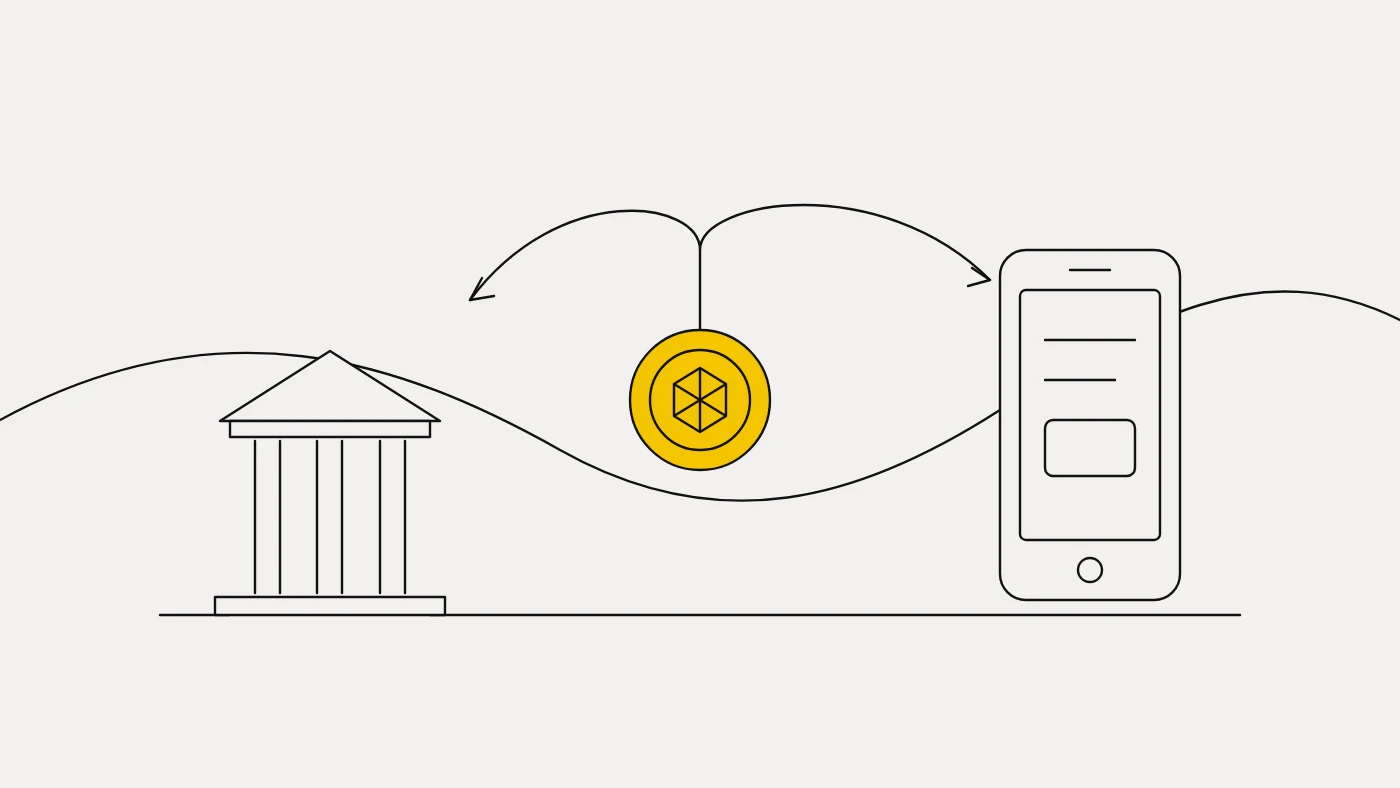
Bienrock helps crypto exchanges, wallets, OTC desks and crypto-enabled companies choose between banks and EMIs for crypto company banking. We support provider selection and application preparation; approval remains the financial institution’s decision.
Key takeaways
- There is no “best bank for a crypto business” in general. There is an institution whose currencies, rails, license and risk appetite fit one company’s actual flows.
- A bank holds deposits on its own balance sheet; an EMI issues e-money and must safeguard client funds instead of using them. That difference shapes what each can do for a crypto company.
- The choice is usually decided by six criteria: currencies, payment rails, license status on both sides, counterparties, onboarding depth, and how the setup survives losing one institution.
- EMIs are often more open to crypto businesses. Banks are harder to access but offer what an EMI cannot, such as general lending and, in some regimes, the account type required for client money.
- For most crypto companies the answer is a combination: a bank and an EMI that do not depend on the same underlying partner.
- Bienrock is not a bank. It assesses which type of institution fits the company’s flows and introduces it to banks, EMIs, OTC desks and payment providers whose risk appetite covers crypto.
Introduction
A crypto company searching for the best bank for its business usually finds lists: ten “crypto-friendly” banks, a few fintech apps, a fee comparison. The founder picks two names and applies. One declines within days. The other opens an account that cannot receive the currency the company’s customers pay in.
The list did not fail because the institutions were bad. It answered a question the company did not have. An exchange collecting euros from retail users, an OTC desk settling dollars with institutions, and a software company accepting stablecoin payments need different things from whoever holds their fiat. Whether that is a bank or an electronic money institution (EMI) follows from those needs.
This post covers what actually separates a bank from an EMI for a crypto business, the criteria that decide the choice, how the answer changes by business model, and why most companies end up with both.
What the Bank vs EMI Decision Actually Means
The bank vs EMI decision is the choice of which type of regulated institution will hold a crypto company’s fiat money and move it on the payment rails the business needs. It is not a ranking. A bank and an EMI hold different licenses, carry different obligations toward client money, and offer different services. The right choice is the institution whose license and capabilities match the company’s currencies, rails, counterparties and regulatory obligations, and whose risk appetite covers its type of crypto activity.
The question is not “which institution will accept us?” It is “which institution can do what our flows require, and keep doing it?” An account that opens quickly but cannot receive the main collection currency, or is closed at the first portfolio review, costs more time than a slower application to the right institution.
Why “Best Bank for Crypto” Lists Rarely Help
Risk appetite is not a fixed label. Institutions that accept crypto businesses tier them by type. A licensed exchange may be accepted where a token project is not; a Web3 software company may pass where an OTC desk is declined.
Appetite changes. Banks and EMIs revise their crypto policies during portfolio reviews. An institution that onboarded crypto companies last year may have closed that door, or narrowed it to licensed entities in certain jurisdictions.
Capabilities differ more than names suggest. Two “crypto-friendly” institutions may offer completely different currencies, rails, limits and account types.
The useful comparison is between what a company needs and what a type of institution can provide.
What Each Institution Actually Is
This is general information, not legal advice; the details depend on the jurisdiction and the specific license.
A bank
A bank (credit institution) is licensed to take deposits and to lend. Money a company holds at a bank is a deposit: a claim on the bank, which the bank can use in its own business. Banks connect to correspondent networks and offer credit and treasury products. For a crypto company, this means:
- banks are generally the hardest institutions to access, and most decline any business with crypto activity in its description;
- a bank can offer services an EMI cannot, including general lending and, where a regulator requires it, an account of the type needed for client money;
- the company is exposed to the bank itself, so the bank’s own standing matters.
An EMI
An electronic money institution is not a bank. It issues electronic money and provides payment accounts and payment services. It does not lend out client funds the way a bank uses deposits. Instead, it must safeguard them, typically in a segregated safeguarding account at a bank or through an insurance policy or comparable guarantee, depending on the regime. For a crypto company, this means:
- money held with an EMI is not a bank deposit; its protection comes from safeguarding, not from deposit guarantee schemes;
- the EMI itself relies on banks, for safeguarding and often for access to payment schemes and correspondent networks;
- EMIs are often more willing than banks to onboard crypto businesses and are frequently faster to work with;
- some requirements can only be met with a bank account. In the EU, MiCA sets rules on where certain crypto-asset service providers must place client funds, and an EMI account alone may not satisfy them, as explained in how to establish banking infrastructure for a crypto-enabled company.
The difference is not prestige. It is what the institution is allowed to do with the money, and who it depends on.
The Six Criteria That Decide the Choice
Requirements differ by institution and jurisdiction. These are the criteria that most often decide whether a bank, an EMI, or both fit a crypto company.
1. Currencies
Start with the currencies customers pay in, counterparties settle in, and the company spends in. A company that collects euros from users, settles dollars with liquidity providers, and pays staff in pounds has three separate requirements. For each, check whether the institution holds that currency in an account in the company’s own name or only through a pooled or converted structure, and whether the company can both receive and send in it.
USD is where the choice narrows most. Dollar payments usually depend on correspondent banking, and many institutions that offer euro accounts to crypto companies offer dollars on narrower terms or not at all.
2. Payment rails
Currencies and rails go together. At a general level:
- SEPA moves euro payments within the Single Euro Payments Area and is the main rail for collecting from and paying out to European users.
- Faster Payments is the UK’s domestic rail for near-instant sterling transfers.
- SWIFT carries cross-border payments between banks, usually through correspondent banks, and is typical for USD settlement with international counterparties.
A bank or an EMI may connect to these schemes directly or through another bank, and each intermediary adds its own screening. Check which rails each account actually supports, whether instant payments are available, and what cut-off times apply, because crypto trades around the clock and fiat rails do not. For companies whose users pay in through these schemes, payment rails deserve their own assessment, separate from the account itself.
3. License status on both sides
The company’s status decides who will consider it. A fully authorized exchange, a firm with a pending application, and a company that believes it needs no license are three different profiles. Some institutions only accept authorized entities; others accept companies in the licensing process. The status has to be stated precisely, including which group entity holds it.
The institution’s license decides what it can hold. Check which license the institution holds, which regulator supervises it, and whether that license covers the services the company needs. Public registers make this verifiable. A provider that presents itself like a bank but holds an e-money or payment license, or offers accounts through a partner named only in its terms, is a different proposition from what its marketing suggests.
4. Counterparties
An institution assesses not only the company but everyone it pays and receives money from: customers, exchanges, OTC desks, liquidity providers, custodians and payment providers. What separates one institution from another:
- whether it accepts payments to and from other crypto businesses, and on what conditions;
- whether it allows only first-party payments (to and from accounts in the counterparty’s own name) or will consider documented third-party flows;
- whether it already serves the company’s main counterparties, which can sometimes make settlement simpler.
An institution comfortable with a software company receiving stablecoin-linked revenue may not be comfortable with daily settlements to a dozen OTC counterparties.
5. Onboarding depth and ongoing review
Onboarding depth is a signal, not just a cost. A bank that runs a long enhanced due diligence process is building an understanding of the business it will rely on later. An institution that opens an account in days on a short questionnaire may run its real review after the first unusual payment, when the account is already in use.
Neither speed nor depth is good in itself. What matters is whether the institution understood the crypto activity at onboarding, whether the account profile reflects normal and peak volumes, and whether the company knows what typically triggers a review. A fast account opened on an incomplete description is the most expensive kind. It tends to fail at the moment the business depends on it.
6. Continuity if one institution exits
Every crypto company should assume that one of its institutions may restrict or close an account at some point, for reasons unrelated to the company: a policy change, a new correspondent requirement, a portfolio review. The question is what happens to collections, payouts and settlement that day. This criterion is where bank and EMI stop being alternatives and become parts of one setup.
How the Answer Changes by Business Model
The six criteria weigh differently by business model. An exchange’s choice is shaped first by its own license and the client funds rules in its jurisdiction; an OTC desk’s by dollar correspondent coverage and limits that match peak settlement volumes; a crypto-enabled company’s by whether the institution accepts exchange-linked inflows at all. How each model typically structures its accounts is covered in how to establish banking infrastructure for a crypto-enabled company.
Bank + EMI: How Redundancy Actually Works
Many crypto companies start with an EMI, because it is the institution that will open an account, and add a bank as the business builds a track record. Others start with a bank for core balances and add an EMI for collections, payouts or a currency the bank does not support. Both patterns can work if each account has a defined role and a realistic backup.
Three principles make redundancy real rather than nominal:
- Different dependencies. Two EMIs that safeguard client funds at the same bank, or reach the same payment scheme through the same sponsor, may fail together. Redundancy means different underlying institutions, not just different brands.
- Overlapping coverage. Each critical flow (main collection currency, main payout rail, main settlement currency) should be possible through at least two accounts.
- Active, accurate accounts. A backup that has never been used, or was opened on a narrower description of the business, may itself trigger a review on the day it is needed.
A bank and an EMI together are not a compromise. For most crypto businesses, it is the design that survives a portfolio review.
How Bienrock Supports Crypto Companies
Bienrock is a consulting company based in Geneva, Switzerland. It is not a bank, does not hold client funds, and does not provide banking services. It acts as an intermediary, assessing which type of institution fits a company’s flows and introducing it to banks, EMIs, OTC desks and payment providers whose risk appetite covers its business type.
The work starts with the money flow, not with a list of institutions. Bienrock selects partners internationally based on currencies, counterparties and flows rather than the country of registration, and checks fit before a formal application, which protects the company’s application history. Every institution knows the company’s crypto activity from day one, and the case goes to decision-makers rather than front-office staff.
A free 30-minute consultation is followed by document collection, typically one to two weeks, and the application and compliance dialogue, usually two to four weeks and up to six for crypto cases. The whole process typically takes four to eight weeks. With 200+ banking partners across Switzerland, the UK, the EU, the UAE, Singapore, Hong Kong, Turkey and Africa, banking redundancy can be planned from the start rather than after the first closure.
FAQ
What is the best bank for a crypto business? There is no single best bank. The right institution depends on the company’s business type, license status, currencies, rails, counterparties and volumes, and on whether the institution’s current risk appetite covers that profile.
Is an EMI safe for a crypto company’s money? An EMI is not a bank, and money held with it is not a bank deposit. It must safeguard client funds, typically in a segregated account at a bank or through insurance or a comparable guarantee. Check the license, the regulator and where funds are safeguarded.
Should a crypto company use a bank or an EMI? Often both. EMIs are frequently more open to crypto businesses; banks offer credit, broader correspondent access and, in some regimes, the account type required for client money.
Do two EMI accounts give a crypto company redundancy? Only if they do not depend on the same underlying institution. Two EMIs that safeguard client funds at the same bank, or reach the same payment scheme through the same sponsor, may fail together.
How long does it take to open a bank or EMI account for a crypto business? With Bienrock, typically four to eight weeks from the first consultation, with the compliance dialogue for crypto cases taking up to six weeks.
Conclusion
Crypto companies rarely fail to find banking because no institution will take them. They fail because they apply to institutions chosen from a list instead of from their own flows. When currencies, rails, license status, counterparties, onboarding depth and continuity are worked out first, the bank vs EMI question usually answers itself, and the answer is often a bank and an EMI with clear roles and independent dependencies.
If your crypto business is choosing between a bank and an EMI, or depends on a single institution today, start with a case assessment at bienrock.ch.